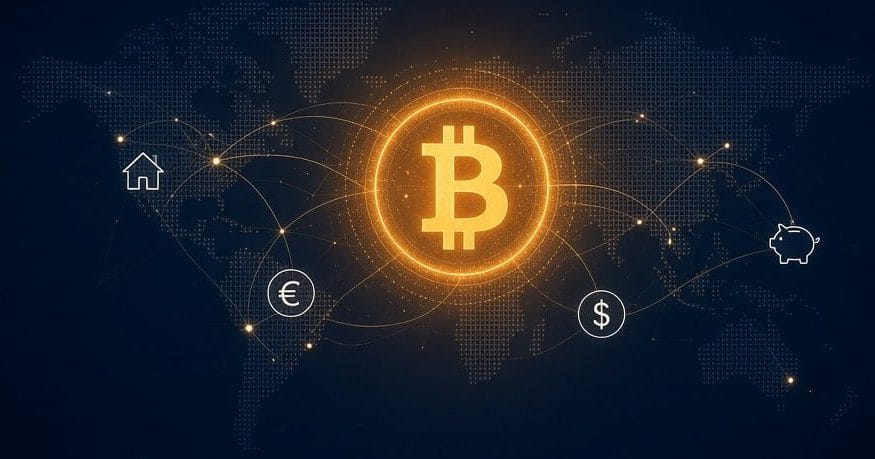

How Does Blockchain Actually Work? The Journey of a Bitcoin Transaction
Imagine sending a digital coin to a friend without a bank in the middle. No paperwork, no waiting days for approval, and no central authority saying “yes” or “no.” It sounds almost too good to be true, yet it happens every second across the globe. But how does blockchain actually work to make this magic possible? Many people hear the term and think of complex math or sci-fi scenarios. However, the reality is much more grounded. It is simply a way for strangers to trust each other without knowing each other. Therefore, let’s dive into the mechanics of this revolutionary technology, starting from the moment you click “send” on your wallet.
How Does Blockchain Actually Work: A Transaction’s Journey
Let’s say you decide to send 0.1 Bitcoin to a friend. Specifically, the moment you hit confirm, your wallet does not just magically teleport the money. Instead, it broadcasts a message to the entire network. This message says: “This person wants to send this specific amount to that address, and here is the cryptographic proof that they are authorized to do it.”
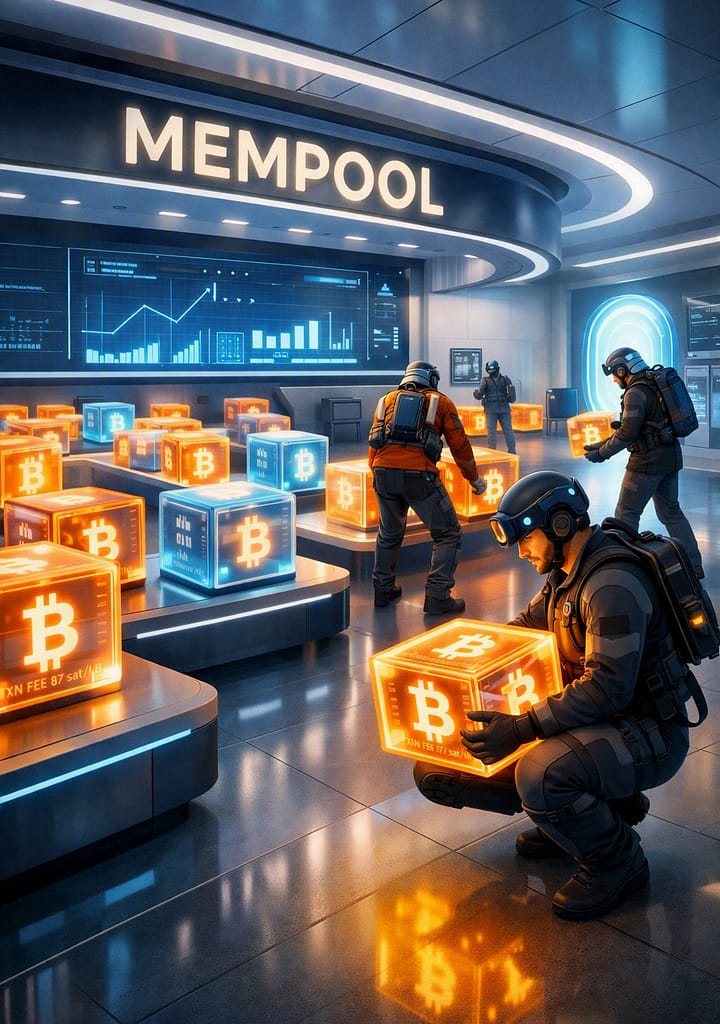
That message does not land directly in your friend’s wallet. Rather, it enters a waiting room called the mempool. Short for memory pool, this is where thousands of unconfirmed transactions sit at any given moment, queuing up to be picked up by the network. Think of it like a busy airport security line; everyone is waiting to get through so they can reach their destination.
Once a miner or validator collects a batch of those transactions, they perform a critical check. First, they verify that none of the transactions are fraudulent, ensuring no one is trying to spend the same coin twice. Subsequently, they bundle these valid transactions into a block. This block is more than just a list; it contains the transactions, a precise timestamp, and a cryptographic link back to the previous block.
From Block to Chain: How Confirmation Happens
Once a block is added to the chain, the transactions inside it are confirmed. Consequently, they become part of the permanent record, copied simultaneously across every node on the network. Crucially, they are linked back to every single block before them, creating an unbreakable chain of history. As a result, your friend’s 0.1 Bitcoin finally arrives at its destination.
But who does that collecting and bundling? Moreover, how does the network decide whose version to trust? This is where we get to one of the most crucial ideas in all of crypto: the consensus mechanism. In fact, this mechanism replaces the traditional bank or referee.
Understanding the Consensus: How Miners and Validators Work
The consensus mechanism is the part of a blockchain that replaces the bank, the referee, or the central authority. Therefore, it is a big part of what makes cryptocurrencies different from anything that came before them. So let’s pause here for a second and zoom in on the people who actually run it.
Every transaction that moves from the mempool to the permanent record has to be collected, verified, and committed. Clearly, someone has to do this work. Depending on the type of blockchain, that job belongs to miners or validators. In both cases, they are performing the same essential function: confirming that transactions are legitimate and committing them permanently to the chain. Furthermore, in exchange, they are rewarded with newly created cryptocurrency plus transaction fees. That reward is why the system works without a central authority: participation pays, so people participate.
So what separates miners from validators? Ultimately, it is how they earn the right to add the next block. That difference is the whole story behind the two consensus mechanisms called Proof-of-Work and Proof-of-Stake.
Proof-of-Work: The Competitive Exam Explained
First, let’s break down the former. Think of Proof-of-Work as an exam where every student is solving the same difficult problem. The student who submits the correct answer first gets the grade and the prize. Conversely, all the others receive nothing.
In Bitcoin, this “exam” is a computational puzzle. Miners run specialized hardware that goes through billions of possible answers per second, trying to find one that satisfies a specific mathematical condition. There is no shortcut. Indeed, the only way to win is to guess faster than everyone else. That is why the only edge here is raw computing power.
When a miner finds the answer, they broadcast their new block to the network. Simultaneously, other nodes verify the answer almost instantly. Checking is easy, even though finding the answer was hard. If the block is valid, it is added to the chain. Then, the winning miner collects the reward, and the race begins again.
Bitcoin has run this way since 2009. Additionally, the puzzle’s difficulty adjusts automatically every two weeks. This way, no matter how much computing power is on the network, a new block appears roughly every ten minutes.
The Energy Debate: A Downside to Proof-of-Work
However, there is a downside to this. All that competitive computation consumes enormous amounts of electricity. Miners around the world are running hardware around the clock, and the vast majority of that effort produces nothing except heat. In fact, the losing guesses are discarded; only one miner’s work actually counts per block.
This process requires significant amounts of energy. Supporters view that energy expenditure as the cost of securing a decentralized network. On the other hand, critics argue that the requirements are too high. The debate remains one of the most discussed aspects of Bitcoin’s design.
Proof-of-Stake: A Different Approach to Security
Proof-of-Stake was developed as an alternative approach, aiming to secure a blockchain without relying on large-scale computational competition. Let’s break down exactly how it does that.
Proof-of-Stake approaches the problem differently. For instance, Ethereum switched from Proof-of-Work to Proof-of-Stake in 2022, in a transition known as “The Merge.” Instead of thousands of miners competing to win a computational race, validators are selected by lottery. Since this process doesn’t require large amounts of computational power, Ethereum’s energy consumption fell by more than 99% after the transition. Rather than relying on computing power for security, Proof-of-Stake relies on participants having financial value at risk.
How Staking and Lotteries Replace Mining
Instead of competing through computation, participants put up a financial stake. Specifically, this means they lock up a certain amount of cryptocurrency as collateral. The protocol then selects one of them to create the next block, roughly in proportion to how much they’ve staked. In simple terms, the more cryptocurrency a participant commits to the network, the more likely they are to help secure it and earn rewards.
A lottery would be the closest analogy to this process. The tickets are purchased with locked crypto. And unlike a lottery, where losing means losing your ticket, validators who follow the rules keep their stake. However, validators who try to cheat by submitting fraudulent transactions can have their staked funds slashed, which means the protocol takes a portion as a penalty.
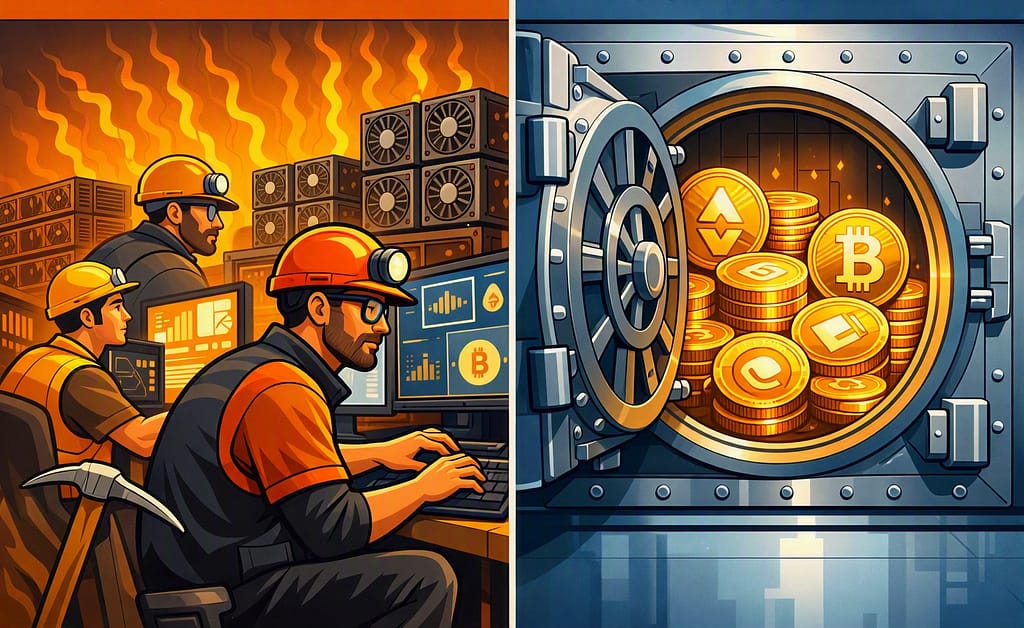
The tradeoff is that Proof-of-Stake requires participants to already hold crypto. Critics argue that this can concentrate influence among the wealthiest stakeholders. Conversely, supporters counter that slashing mechanisms align validators’ incentives with the network’s health. For example, a validator with millions of dollars worth of ETH at stake has a strong reason to play fair.
Why Consensus is Key to Security
But that’s just an individual incentive. The bigger question is what happens when someone decides to go after the whole network. And not just submit a bad block, but attempt to take over the entire record.
You might be wondering what stops someone from cheating the network. Well, first of all, it’s quite costly.
In a Proof-of-Work system, cheating would require controlling more than half the network’s total computing power, which is called a 51% attack. On a large network like Bitcoin, the hardware and energy required to pull this off would cost billions of dollars — more than any attacker could realistically gain. That’s why it remains theoretical for major chains.
In Proof-of-Stake, the equivalent would require controlling more than half the total staked supply. On Ethereum, that means acquiring and locking up tens of billions of dollars worth of ETH. Even then, the attempt would likely trigger slashing and destroy much of the attacker’s stake in the process.
In theory, neither mechanism is immune to attack. But both of them make cheating so expensive, that honest participation is far more rational than manipulation. Ultimately, the practical logic of consensus is economic, rather than moral.
Conclusion: Mastering How Does Blockchain Actually Work
Before we wrap up, it’s worth remembering that you don’t need to understand consensus mechanisms to use cryptocurrency. Just as you don’t need to understand plumbing to turn on a tap, you don’t need to understand blockchain consensus to send or receive crypto.
What we’ve covered in this lesson is the machinery operating behind the scenes: the process that verifies transactions, secures the network, and keeps the system running without a central authority. We followed the journey of a transaction, examined the roles of miners and validators, and compared the two main consensus mechanisms: Proof of Work and Proof of Stake.
Understanding how does blockchain actually work gives you a deeper appreciation for the innovation behind Bitcoin. Indeed, it is not just money; it is a new way of organizing trust in the digital age. Whether you are a long-time holder or just starting your journey, knowing the mechanics helps you navigate the space with confidence.
In the next lesson, we’ll explore the cryptocurrency landscape: Bitcoin, altcoins, and stablecoins, what makes them different, and why so many of them exist. Stay tuned as we continue to break down the world of crypto, one block at a time.
⚡ Do you appreciate this content?
Writing these articles takes time, research, and passion. If you found this explanation valuable and would like to contribute to creating more free, independent content about Bitcoin and the future of money, you can send a small donation via Bitcoin Lightning. The Lightning Network makes it possible to send micro-donations with minimal transaction fees, which fits perfectly with the philosophy of Bitcoin.
Every satoshi, no matter how small, helps to maintain this site and create more educational content. Your support makes a difference and contributes to a freer, more transparent financial system.
? Lightning address: danielle_btc@blink.sv
Thank you for reading along and being part of this journey. Let’s shape the future of money together, one block at a time. ₿
